
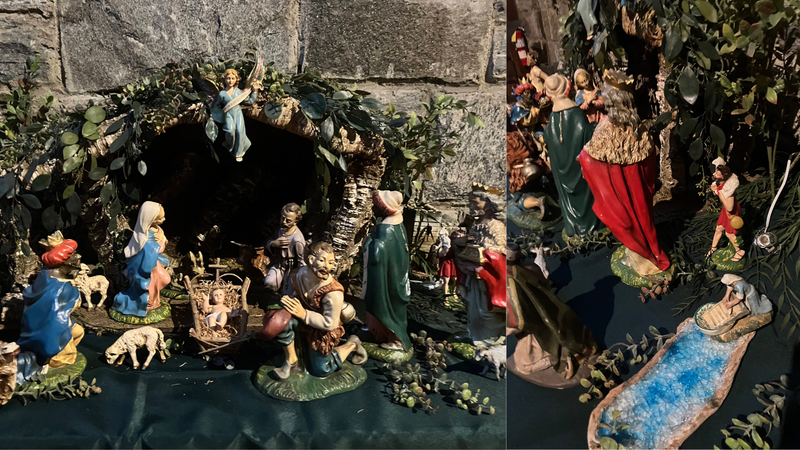
[Pictured--our creche at St. James, which these photos don't even begin to capture!]
Merry Christmas!! Bet you’re not hearing that much any more. But I’m going to keep saying it - Merry Christmas!
We’re not done with the season, and in fact, a large portion of the Christian world hasn’t even gotten to their Christmas Day. The Eastern Orthodox churches begin the season of Christmas starting this Wednesday, January 7. I was made very much aware of this five years ago when a group from St. James traveled to the Holy Land, where there are all varieties of Christians (though far fewer of us over there than there once were). It was an unexpected treat on that trip to have gotten through all of our Christmas celebrations over here only to repeat the whole thing again over there.
Back here though, and among those of us who trace our roots to the customs of the West, or Rome, tomorrow is day twelve, the last day of Christmas. Epiphany follows on January 6, when we celebrate the arrival of the wise men to the child Jesus. Their arrival marks the start of a new season in the church, but to many of us, they’re the culmination of Christmas, the final ones to reach the manger and complete this perfect scene of worshippers around the holy family.
I used to make us hold back the wise men and camels from the creche until (at the earliest) this second Sunday of Christmas. Now I’m just happy if somebody puts the thing up. But it was my attempt, back in my more rigid and exacting days, to remind us that this whole grand tableau that we so adore, with the shepherds, the angels, the wise men and their gifts, the sheep, the oxen, mother and father all gathered around a newborn babe--is not really how the Gospels tell the story.
The arrival of the shepherds and the arrival of the wise men are told in entirely different Gospels, neither with any seeming awareness of the other. In Luke, the local Judean shepherds visit Jesus in a stable the very night of the birth and they have only to travel from the fields of Bethlehem to its village, behind an inn, in a barn (or maybe a cave) where the baby Jesus lay.
In Matthew, it’s wise men, foreigners, Gentiles, who visit the child, and they take who knows how long to arrive--days, months maybe. Some sources say up to a year or more. Herod’s decree to slaughter all the children in Bethlehem under 2 years old for fear one of them really is the king that the wise men came so far to see, makes it seem that Jesus, by the time of their visit, could have been a toddler. In which case the wise men surely didn’t visit this stable, but a home, wherever Joseph and Mary (according to Matthew’s Gospel) spent those first couple years while still living in Bethlehem.
Something in us, though, resists this gradual, fragmented picture of the Nativity.
As early as the second century, a Christian named Tatian composed the Diatesseron, a single-volume harmonized account of all four of our Gospels, ridding them of their discrepancies and contradictions. There’s no surviving manuscript of the work--we know about it through other sources--and we’ve no detail of what he did with the Nativity accounts, but I’d bet that the mashing together of all these people and moments started with him. In any case, pretty early in the Christian tradition we imagined one night with a star, and a stable packed with all those that ever laid eyes on the child Jesus--not just the shepherds and magi, his parents and a few angels, but (pretty soon) others, as well: curious villagers, a midwife, Mary’s mother!, exotic animals like peacocks and zebras.
Boris Pasternack, the Russian poet, has a famous Christmas poem called the Star of the Nativity. It’s kind of a verbal arrangement of the creche, these figures, what we have here next to the pulpit, but in words. Throngs of admirers come to worship the newborn child. The shepherds, angels, the kings--they’re all there, all streaming towards the manger in this glorious procession. When they get there, though, a practical and somewhat incredulous Mary stands at the door, looking at them all, saying:
“You can’t all come in.
Some must wait here.”
Spoken like a woman :)
Of course they can’t all come in! It doesn’t work. And that doesn’t matter. Because these visitors, finally here, after days of travel but with everyone else impossibly still there and still adoring, in that cold, under that one roof on that one night, speaks to a need we have to see this story that way. Our desire isn’t for historical or textual accuracy. It’s a yearning for a place and a faith where we know everyone belongs, and everyone can be together, whatever their background, whatever their means, they’re here, we’re here, side by side, united by the simple act of worship, of fixing our gaze on something, someone, outside of and greater than ourselves.
Think of it as the first church service.
Today’s the last Sunday of Christmas, tomorrow the last day. Soon we’ll put the creche, all this away in storage for another year. But we here gathered are the embodiment of that first night, or what we imagine it to be. And what we imagine it to be is just as important as what it was. So week after week as we gather here, may we remember that we’re the living shepherds, and magi, and angels, and sheep and lambs and dogs and chickens and all variety of God’s creatures under the sun (or star), diverse and wonderful, whom we remember on this last Sunday of Christmas.