
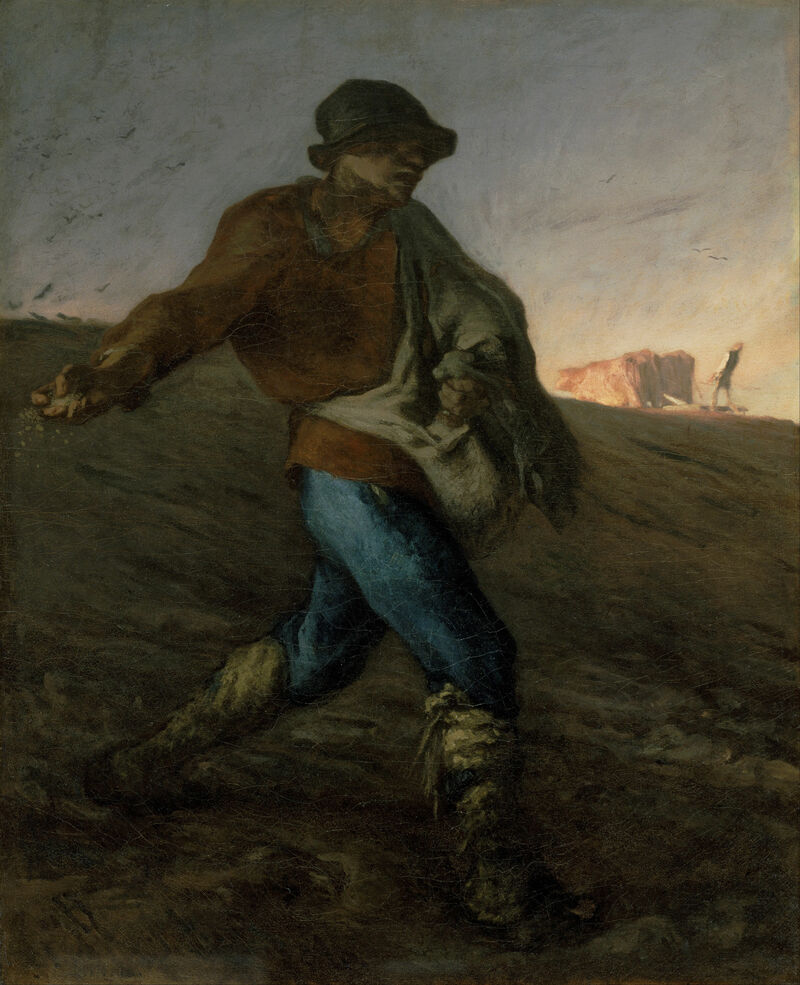
Good morning - what a lovely Sunday morning, at last! And we’re outside to enjoy it.
Worship outdoors is fitting for a parable like today’s—not only because it’s about nature, and seeds, and soil like what surrounds us here, but also because Jesus would have shared these words outdoors, where so much of his preaching happened. Hearing the Gospel read amid the chattering of the birds and rushing of wind, the lapping of water on the shore, is how Jesus’ words were first heard, and we can forget that after centuries putting all this indoors in our dark stone churches as we do—also lovely, just far from what it was in Jesus’ day.
Today’s parable is a perfect one for summer. I suspect that’s why it’s placed here. It’s called either the Parable of the Sower or the Parable of the Soils, depending on what you focus on—and we’ll focus on both.
A sower takes up his seed, goes out and starts scattering it—freely, indiscriminately, and it falls on all different types of ground: rocky ground, thorny ground, shallow ground, and ground with rich soil that takes the seeds. The results are as you’d expect: not much grows in the rocky or the thorny soils. The seeds scattered in the shallow soil wither with the hot sun, not having the proper moisture to surround, protect and feed them. But the seeds sown in the rich soil take root, and grow an abundant harvest.
I suppose if you were a farmer, you might wonder about this sower, what he was doing just throwing away his precious seed in places he couldn’t possibly think it would take hold. It’s a foolish, indefensible way of growing food, but of course this isn’t any ordinary farmer; it’s God, whose grace is limitless and who can afford to just throw it around without fear of it running out.
Time and again when Jesus puts God in the place of a farmer, or shepherd, or father or judge God seems to be very bad at his job. Giving too much away, showing excess concern for the one over the many, forgetting or ignoring the proper order of things, showing an amount of mercy that couldn’t possibly be countenanced in real life. If grace were true—and it is; I should say If we trusted grace to be true, like God—then we might operate with a little more daring and mercy as well. Perhaps this generous and indiscriminate sower is meant to be an example for us, as well as to teach us something about God.
The other way of looking at this parable is to focus on the various soils, and I’m guessing when we hear this we’re mostly thinking about what kind of soil we might be—or I should say, what kind of soil we might be this year on hearing this. Because of course we’re sometimes rocky, sometimes thorny, but sometimes also receptive and ready for what God plants in us. That’s how a life goes.
I come from a family of farmers, as many here know. Soil is of particular interest—to any farmer, but very much my relatives. They live in central Missouri, where soil erosion has become a big problem. Soil there if it’s not cared for properly will wash out, eventually making its way to the Mississippi River and down to the Delta and into the sea where it’s gone forever, at least for those farmers and their fields.
My relatives have made it one of their life’s projects to teach people not to overfarm their land, which depletes the soil and leads to erosion. They’ve rewilded prairie lands forever so as to trap in any soil that runs this way or that—and/or save the land for future generations. Whenever I visit I never miss the tour my uncle likes to take us on, loading up in his mini tractor and checking out the nearest vulnerable fields.
Two observations I’ve gleaned from following my family’s work out there.
First, that lying fallow is one of the best things you can do to create rich, productive soil. You simply can’t have soil working all the time; it needs to rest, recharge its nutrients. Doing nothing is spiritually important; that’s why rest features so prominently in all the great religions. I hope this message comes to us at a time when we can do just this, slow down, put down our work and our devices and let our minds wander—our equivalent of letting the field rest.
And did I mention the value of weeds to fields? Those weeds that crop when we’re just letting be, [those weeds] do a lot of good work and (though this is really a message for a different parable, the parable of the wheat and the weeds) I want us to remember that a perfect looking field isn’t necessarily a healthy one, sometimes quite the contrary. A life that’s seen a few weeds is a far healthier one than not.
The second lesson I’ve gleaned from my family of farmers is that soil isn’t an individual, personal matter. If the person’s field next to yours is washing out, you go over and help them with that. For one, those rills may come for your fields too if he doesn’t do something about them. We never live in isolation. Soil belongs to a larger system, where the condition of our neighbor’s field can matter a lot to how ours is doing. And vice versa.
I’ve heard this communal approach to this parable in recent years, and I like it. It comports with nature, and it’s what we need. Knowing that what we do affects another and working together to make sure all of us thrive--these are good lessons for our time.
So - the parable of the sower, and the parable of the soils. The first, teaching us the importance of abandon when it comes to grace--towards us from God, and also by us, to others. Scatter seeds of love and kindness, generosity and forgiveness, not worrying about where and whether they land. Err on the side of overdoing it in these things.
And then the second teaching us how tending our soil isn’t just our own business; not much separates our field from our neighbor’s, and we need to be healthy and whole together, helping each other where needed.
Good lessons from nature on a resplendent summer day. May they now take root in us. Amen.