
John the Baptist.
He’s back!
And aren’t we lucky?
Every third year in the season of Advent we have John not once but twice. He takes us almost all the way to the end. Next weekend is the last Sunday of Advent and then it’s Christmas.
Today John is in a very different place from where we met him last week. There he was at the height of his powers, baptizing, urging people to repentance. So much at the height of his powers that he felt emboldened to call the religious leaders coming to him for — whatever they were coming to him for — a brood of vipers. “You brood of vipers! Who warned you to flee from the wrath to come?!”
Fast forward some months, maybe a year or two, and now John is in prison, about to pay the price for speaking boldly and in high places. He’ll soon be killed for publicly condemning the marriage of Herod Antipas to his sister-in-law Herodias. (When I was a kid I remember thinking it so odd that two people with the same name would get married, Herod and Herodias--it was just one more of those strange things about the Bible, like cousins marrying! Such memories always remind me that kids listen in church.)
It always seems to me one of the boldest decisions of the church to put John here, and not just John the loud grumpy locust-eating scold of Advent 2, but John in prison, and greatly diminished, as we find him this week. This year it’s juxtaposed with the third Sunday of Advent, which is a traditional day for rejoicing and a turning point in the season.
I guess the plainest meaning of this reading here is that John the Baptist, for Christians, straddles the old world and the new. He pointed to what was to come, but he didn’t fully understand it and didn’t live to see it come to pass. He was limited by his time and place and his own ideas of things. Like many prophets he planted the seed but it would be for others, not him, to water and witness the growth.
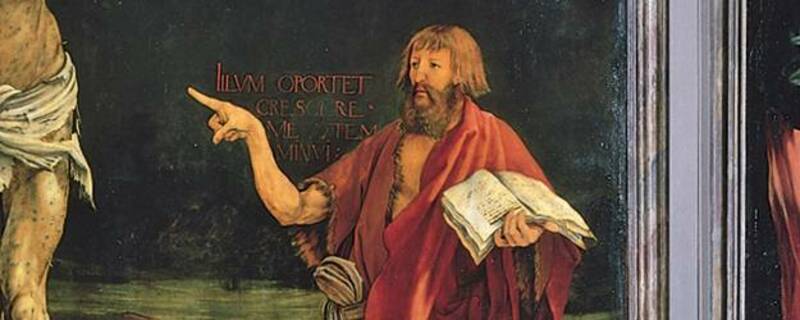
One of my lifelong dreams is to go see the Isenheim Altar in Colsace, France. Mattias Grunewald is the artist—15th century, German. His John the Baptist IS John the Baptist. Sinewy, shaggy, finger arched and pointed, hair like straw, maybe a little Germanic, but we’ll forgive him that. Though harder to accept is how the camel’s fur that John famously wore, a marker of his asceticism, in Grunewald’s vision becomes the lining (and a nice looking lining) of his cloak.
Grunewald places John not at the Jordan or in the Judean wilderness where his ministry began, but at the foot of the cross, where of course he never would have stood because his life was taken early from him, and which, you sense, the earthly John in any case would have struggled to understand.
John’s final words to Jesus, from today’s reading: are you the one to come or are we to expect another? Because, it doesn’t even need to be stated, you don’t have a winnowing fork, and fire, like I said you would. You’re not separating the wheat from the chaff, and putting the bad into the furnace and the good into the granary. Like I thought you’d do. You aren’t standing with an ax at the root of the tree preparing to cut down those who don’t bear good fruit. Like I think you should.
So, are you the one to come, or are we to expect another? In reply to John’s question, Jesus sends his messengers back with a quote from the prophet Isaiah: “Go and tell John what you hear and see: the blind receive their sight, the lame walk, the lepers are cleansed, the deaf hear, the dead are raised, and the poor have good news brought to them.”
Will that convince John? Probably not. Jesus doesn’t even seem to think so, hence his ending words: “And blessed is anyone who takes no offense at me.” Unlike John, who in this passage, does seem to take offense.
As I said, we’re at a turning point in Advent, leaving now (in Christian terms) the old order embodied by John the prophet, and embracing the new. John didn’t live to see it, and he took his doubts about it to the grave.
But Jesus never wavered when it came to John. Of those born of women, Jesus says--in other words of all that live--no one is greater than John the Baptist. To understand partially is part of the human condition. And if we can only point in the right direction, God will do the rest, and reward us for that. But more, the age of grace is upon us. Nothing excludes us from God’s love in Jesus—not our doubts, our partial vision, our failure to see things through to the end.
History was as kind and generous to John as Jesus was. He has six feast days during the year in his honor. Plus he takes pride of place in Advent, when the pews are starting to fill up. All the major branches of Christianity revere him, and Dante even puts him at the pinnacle of paradise in the Divine Comedy.
John ushered in an age of grace and though he didn’t always show it himself, he was among the first to receive it, wholly and unconditionally. And the best news of today’s reading is that it doesn’t end with John: Even the least among us is greater in God’s eyes than John the Baptist.
So on this third Sunday in Advent, as we say goodbye to John the Baptist and look forward to lighter, brighter days ahead, there is much to celebrate.