
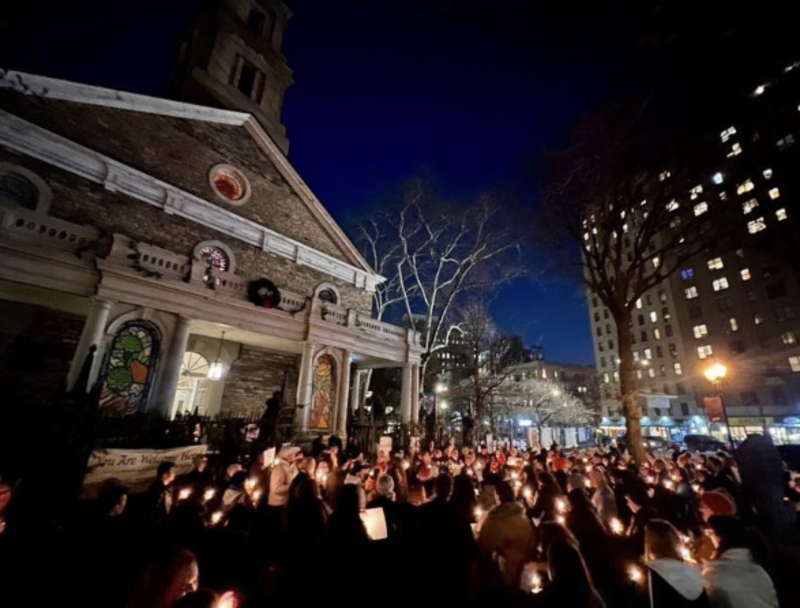
[Pictured: a recent vigil at St. Mark's Episcopal Church in the Bowery]
Good morning! We have a few occasions to celebrate this weekend. First, we have a baptism--of Charles House, son of new parishioners Simone and Joseph and little brother of Penelope. We're so happy to be part of this big day in his life, and I want to welcome also friends, extended family, godparents who are here with us. Joseph and Simone began attending last fall. You picked a good Sunday for baptism, with all this incredible music!
The other occasion this weekend is, of course, the celebration of the life and legacy of Martin Luther King. Tomorrow morning I hope you'll consider joining me and my family at Holy Trinity Episcopal Church in the Bronx for the annual diocesan celebration. The new dean of our Cathedral of St. John the Divine will be preaching, with the bishop celebrating Communion.
Among King's most challenging observations was how segregated Sunday mornings are in our culture, when the very opposite should be true. And here we are, so many years later, still falling short of King's vision of a "beloved community," where all God's people of every race and tribe can worship side by side without fear, resentment or condescension.
This said, these services in the Bronx are about as close as you can get to the way things should be, and I make a point never to miss it.
We are now two weeks into the season of Epiphany. Epiphany means appearance or manifestation. It’s a season in the church when we read about the various ways God is made manifest to us. It’s also a season that calls us to make God manifest and known to the world. That is the thru-line in our readings for today.
In John’s account of the calling of the disciples, which is unlike any of the other accounts of this event we have in our Gospels, Jesus doesn’t go one by one hand selecting each disciple and telling them to Come Follow. That’s the way Matthew, Mark and Luke tell it--Jesus on the seashore, calling out to his soon-to-be-disciples in their boats, telling them to leave their nets and follow, which they do. In this lesser-known version from the Gospel of John, the disciples aren’t called individually by Jesus to be disciples. They tell, and are called by, each other. John the Baptist tells Andrew and the unnamed disciple. The two follow Jesus and stay with him. The next day, they go and tell Peter, who comes and meets Jesus, and who then goes and tells Nathanael -- and so on. They make Christ known to each other. That’s how Jesus’ band of disciples begins to form in this account, by their proclamation.
In the Old Testament reading from Isaiah, God calls the prophet, his servant, to proclaim his name not only to his own people, Israel, but even further, to the ends of the earth. In Epiphany, we celebrate the reach of the Gospel to all people, and so this reading here today. Likewise Paul, who once received the blinding vision of Christ on the road to Damascus (the feast day celebrating that event is next week, in fact), was the chief proclaimer in the early church. Through his travels, sermons, and especially letters like the one we read from today, he made God’s love and grace known to thousands in his day.
But I was particularly moved by this week’s Psalm, a Psalm whose authorship and context are lost to us, and one that we don’t typically count among the more distinguished of the Psalms. But there’s this line in it, where the Psalmist speaks directly to God, bold and proud:
I proclaimed righteousness in the great congregation;
behold, I did not restrain my lips;
and that, O Lord, you know.
Your righteousness have I not hidden in my heart;
I have spoken of your faithfulness and your deliverance;
I have not concealed your love and faithfulness from the great congregation.
It almost reads like an epitaph, words you would want to be remembered by after your death: “I did not restrain my lips. Your righteousness have I not hidden in my heart. I have not concealed your faithfulness.” I wonder if we can say the same. That when it came time to speak, we did not remain silent. Or hide God’s message in our hearts rather than speak it with our lips, to the great congregation.
Exactly one year before he was assassinated, Dr. King preached a sermon at Riverside Church in Manhattan. By that point, he was suffering from overwork and exhaustion, and almost didn’t accept the invitation. The occasion was a protest against the war in Vietnam, a cause he became involved with toward the end of his life. He did go. And in his sermon, he said he decided to participate because There comes a time when Silence is a form of betrayal.
It astounds me that King, Martin Luther King, would think he’s in danger of not speaking out, of growing lax, someone who spent his whole life and ran himself into the ground speaking the truth and proclaiming the Gospel. He never let up on this high standard he set for himself to speak up, and out, boldly, and without fail.
So the question for us today, posed both by our readings and by the life and teachings of the incredible man we honor this weekend: [the question for us is]: Where are we silent when we should be speaking? Are we proclaiming Christ, making him manifest in our world, to the fullest of our ability? And what does that mean in our time and place?
I don’t think I’m going out on a limb to say, I think we know what Dr. King today would tell us to not be silent about. In our country, there’s so much--and right now I’m thinking especially of the people of Minnesota and all the brave women and men trying to protect and support the vulnerable population there. Or in Orange County, where many, including our very own Episcopal brothers and sisters, are fighting hard to make sure the people in their community can live without fear of being apprehended and detained. King in his later years (as you probably know) turned his attention to the northern states, and the racism there. I want to think we’re seeing the fruits of his labors now, in the protection by its white citizens of their non-white friends and neighbors. But of course the picture is still complicated, and there’s still so much work to be done.
Throughout his career and very much in his later years, King was engaged with global affairs and I think he would have much to say in support of the people of Iran, and of the repressive role religion (and governments) can play when it’s defined and controlled by a select few with concern for power and control rather than human flourishing, inclusion, and freedom.
Of course I could go on. You don’t need me. In fact, it’s on all of us to think about these things on our own, all the time. This season in the church reminds us of that. Because (again) Epiphany is not just about beholding God as he comes to us; it’s about proclaiming God’s love, mercy, and justice to the world.
We’ll reaffirm our commitment to this vision of the world (and our part to play in it) in just a few minutes when we say the baptismal covenant. We’ll welcome this new child into the faith not just for comfort and belonging but to be, one day, a witness of the Gospel with all the courage that’s involved with that.
I’m going to leave us with words from Howard Thurman, a theologian who profoundly influenced Dr. King and knew him personally. I’ve always loved these words and finally found a place for them. This comes from his book The Mood of Christmas:
When the song of the angels is stilled,
When the star in the sky is gone,
When the kings and princes are home,
When the shepherds are back with their flocks,
The work of Christmas begins:
To find the lost,
To heal the broken,
To feed the hungry,
To release the prisoner,
To rebuild the nations,
To bring peace among the people,
To make music in the heart.
Amen.