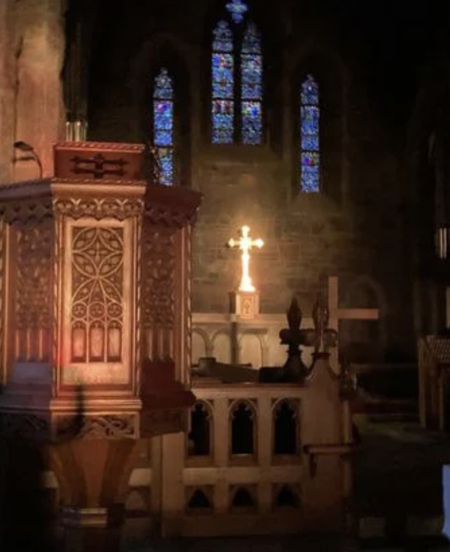
Good evening, so glad you’re here. I always say that at these quieter services because I know it takes an extra effort to make them a part of your lives, and I’m just always delighted that there are people to share these moments with.
Tonight begins the Easter Triduum, the most important three days of the most important week in the church.
The Triduum starts on Maundy Thursday and will go until Holy Saturday evening, when Easter officially begins. As those who’ve been through this before know, anything can happen inside of us as we walk through the last supper, the betrayal and abandonment in the Garden (both tonight), the crucifixion and desertion by the disciples at the cross (tomorrow), and then the eerie silent days of Friday to Saturday when Jesus lay in the tomb.
We’re never the same person when we come to these days, and what we take from them every year is in some way, sometimes barely perceptible, sometimes blazingly obvious, different.
We grow by these stories, and especially those we hear and enter into these three most sacred days.
------
This year I had an idea to share, both tonight and tomorrow, something from our church’s library.
Three committed women of the parish--Jan Lamb, Francia Morhardt, and Linda Killian--have devoted themselves to going through over 100 years of books amassed (for the most part) without vision or purpose and crammed in no particular order in the bookshelves throughout the church. Clergy have a very bad habit of offloading their unwanted books onto church libraries, and I suspect that’s where many of these come from.
Our library women have left several piles for me to sort through, to determine what’s worth keeping and what’s not. So, to maximize my time, I thought Why not combine this with my Holy Week preparations, and see if, in sorting through these books, I can find some passages to share for the Maundy Thursday and Good Friday services.
Good Friday came very easily. I found the best reflection for tomorrow right after I came up with this idea. I can’t wait to share it.
Tonight’s was a little harder, but patience (I think) paid off.
I knew I wanted a reflection about the Eucharist, because this is the night we devote to that first Eucharist that Jesus shared with his friends.
In addition--and I hope you don’t mind me bringing together loosely different threads here--a week ago yesterday I had the privilege of taking Communion to our former rector, who, as many in the congregation know, has been very ill. The passage I’m about to read I found the very morning I was going to see him, and I just knew, priest-to-priest, it was the thing I wanted to take and share in my short time with him and his wife.
So as I read this, I hope it might take on extra meaning knowing it was so recently read to someone many here love, but whose days are coming to a close.
All of us here, too, will have a final Eucharist. We may or may not know it’s the last time we receive, when that comes. As we remember Jesus’ last meal with his friends, we think about what a blessing it is that 2000 years ago Jesus, this night, instituted a ritual that would give life and purpose to billions over centuries, and to each of us.
Last Wednesday’s Eucharist was not our friend's last. But I would be honored if someone read this passage to me when the days come that I no longer take my remaining days, and Eucharists, for granted.
The book is “Darkness No Darkness” by Raymond Raynes, a monk and priest in the Church of England last century. Turns out his order, based in England, was also active in South Africa and that Father Raynes was an outspoken defender of the rights and equality of black people in that society.
I think you can hear it even in this passage the kind of man he was.
Just two things to mention before I read it:
Towards the end he talks about the ancient church’s idea of the Eucharist being “medicine for immortality.” That’s always been a deep part of my spiritual life, the idea (and I’ve shared this before) that with each wafer we consume we’re building up an interior self that’s strong, and ultimately, immortal.
Another idea he expresses here--very Anglican or Episcopalian--is the inclusiveness of what we do here tonight. There are and should be no barriers to receiving this gift of grace. Its power isn’t in what we bring to it, but what it is, a gift, freely given, from God. And God takes pleasure in our receiving this gift -- notice in the reading, typical Anglican, all the uses of the words “delight,” and “pleasure.”
Let your mind tune in and out as I read--it’s not important to follow the meaning closely, but just to get the gist, and the feeling. I think that’s what Father Raynes would have wanted.
Here’s the passage. It’s about 4 minutes.
The Holy Spirit nourishes the soul not only by inspiring it to pray, but also by directing it towards the sacramental life.
The blessed sacrament of the altar springs naturally to our mind when we begin to think of the sacraments, but we must never forget the other six. We ought from time to time to recall with thankfulness our baptism and confirmation and the times we have received absolution through the sacrament of penance. But, as members of Christ’s body, we ought also to give thanks for the sacraments of holy orders, marriage, and unction. We sometimes forget these, especially if they are sacraments we have not received, perhaps even, we cannot receive them. We must give thanks for them all the same; they are parts of the sacramental life of the church in which we all share. But supremely we should give thanks, and adore God for the most holy sacrament of the altar.
It is difficult to know where to begin and where to end when we meditate on the blessed sacrament. There are so many aspects of it: there is the great dogma of the Real Presence of our blessed Lord under the sacramental forms; there is the sacrifice of the Mass; or our Lord giving himself to us in Holy Communion; or his abiding presence in the tabernacle.
If we take those words of Holy Scripture, ‘My delights are with the sons of men,’ as applying to our Lord, they form the right basis for our adoration of the blessed sacrament, and for our thanksgiving for it. It is the second person of the Holy Trinity who delights to be with us, the Logos, the Wisdom and Word of God, by whom all things were made, and for whose pleasure they are and were created. It is the incarnate Son of God’s delight to be with us, which could be seen so clearly as he went among his friends, his apostles and the crowds of unknown people who besieged him and listened avidly to his words, among the children, the sick and sorrowful--the clear and outward expression of his delight to be with the sons of men, that no one can misunderstand.
It is the same with the blessed sacrament. He is there for all who desire him, and for this he has made himself most accessible. He comes among us on the humblest altar in the poorest church, at the hands of any priest, to one or two as readily and gladly as to the crowds in the great cathedrals and fashionable churches, with the same overwhelming humility as in the Incarnation. He comes as a suppliant seeking admission to the hearts of men, with a love that forces him, compels him to risk and accepts insults, irreverence, ignorance and even sacrilege, if he may but find one heart in which to rest.
I remember talking to one priest, who had the blessed sacrament on the high altar of his church. I suggested that, as many heathen and ignorant people came to his church, and as there was a lot of what might be called irreverence, it might be better to reserve in one of the side chapels. He said that our Lord was content to be with publicans and sinners, and still is.
Our Lord came to satisfy the desire of his soul to be with men, and the weaker desires of our own souls to have him with us. …
In Holy Communion, I receive what the Fathers used to call “the medicine of immortality,” the gift of the great Physician himself. All that Jesus incarnate is, he is for us; and in Holy Communion he gives himself to us as he sees we need him, and as it is possible for us to receive his remedies. So we come regularly and faithfully to receive the medicine of our souls in the spirit of those who need, and in the firm faith that our Lord gives us what is right and good, because we know he gives himself.
[Raymond Raynes, Darkness No Darkness, chapter XII “My Delights are With the Sons of Men,” pp 49-51]