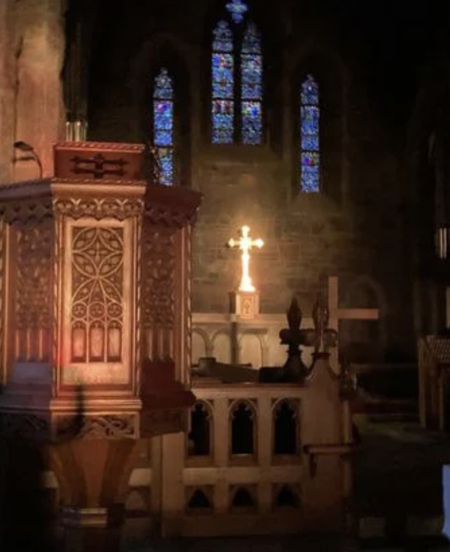
Good afternoon, and welcome to our solemn liturgy for Good Friday, the one service of the year you can’t call beautiful, and wouldn’t want to. We “worship the lord in the beauty of holiness” (to use one of our favorite biblical phrases as Episcopalians) on every day but this one.
Yesterday evening I shared that we’re cleaning out the church library, and I had the idea last month to combine my efforts to sort through all those old books / with my preparation for these two services, Maundy Thursday and Good Friday.
It was a decision made for practical reasons but I’ve also really enjoyed uncovering some gems, mostly obscure and unimportant works, but with passages that deserve to see the light of day once more.
Last night I shared from one Brother Raymond Raynes, an English monk who had an inspiring history working in South Africa in the 1930s. The passage I shared was about the Eucharist, and I hope those who heard it enjoyed it as much as I did.
Today I want to share a very short piece by the Rev. Halford Luccock, who was known pseudonymously as St Simeon Stylites, an early desert monk from Syria who was a bit of an eccentric. These columns, “The Letters of Simeon Stylites,” appeared in the Christian Century magazine, a popular source of liberal Protestant thought in the 20th century, and still exists today.
This writer is clever, inspiring, funny. This column was apparently very popular. What I’ll share in a moment isn’t one of his humorous pieces but was written for Good Friday.
Let me preface it by saying, There’s a whole subset of literature and poetry that likes to consider the ordinary people going about their business on the day of the crucifixión - tending to their everyday preoccupations and concerns, much the same way I suppose most of us would have been. If they did notice the cross, it was the backdrop of their personal drama, not the main event, maybe even barely memorable.
This essayist refers to one such short story, Russian, that features a man nursing a toothache on the day of Christ’s death.
One thing I love about this piece is its easy references to Russian literature and the poet W.H. Auden, reminding me of a time when clergy were steeped in such things and expected to be.
I hope you find this meaningful. It definitely brings Jesus’ death on the cross into our time and world and reminds us this isn’t something from the past, at all. To quote one of the piece’s most powerful lines: “there is a continuing crucifixion going on.”
Good Friday--and a Toothache.
A very short story that deserves a high place on any list of Lenten readin gis one by the Russian novelist Leonid Andreyev--”The Day of the Crucifixion,” in the volume “The Crushed Flower,” published by Alfred A. Knopf. It is one of the shortest stories Andreyev ever wrote, only a few hundred words, but it has a bite that lasts for years. It embodies a striking bit of imagination, which is conveyed in the first sentence:
“On that terrible day when the universal injustice was committed, and Jesus Christ was crucified between robbers on Golgotha--on that day from early morning, Ben-Tovit, a tradesman of Jerusalem, suffered from an unendurable toothache.”
The crucifixion is then described as it appeared to a man preoccupied with an almost exclusive preoccupation, a toothache. Once in a while he becomes dimly aware of the procession of the cross, but soon goes back to his own private woe. His wife urges him to look at the men on the way to their execution, as a means of diversion. Here is Andreyev’s description:
“One of the men, he of the long light hair, in a torn, bloodstained cloak, stumbled over a stone which was thrown under his feet, and he fell. The shouting grew louder, and the crowd, like colored sea water, closed in about the man on the ground. Ben-Tovit suddenly shuddered for pain; he felt as though someone had pierced a red-hot needle through his tooth … He groaned, and walked away.”
Afterward he is led by a friend to see “the criminals on the crosses,” but he does not stay: “He was eager to finish the story of his toothache.”
There is no need to tack a moral to that bit of art. But the author certainly meant us to drop it into our imagination. It brings the humbling picture of missing the meaning of Calvary through any kind of preoccupation.
There is a continuing crucifixion going on, where all that Jesus cared for, taught, lived for, died for is scourged and crucified. Take hold of the wings of the morning and flop around the earth--Korea, South Africa, India, many places in our own country--till you come back to where you started from. Good Friday is here again. How sharply do we see the crucifixion that still goes on? Does it break through the excluding wall of our own private toothache? W.H. Auden has given a vivid an searching picture of a private preoccupation while a tragedy is happening:
We haven’t the time--it’s been such a rush--
Except to attend to our own little push:
The teacher setting examinations,
The journalist writing his falsifications,
The judge enforcing the obsolete law,
The banker making the loan from the war,
The expert designing the long-range gun
To exterminate everyone under the sun,
Would like to get out, but can only mutter,
“What can I do? It’s my bread and butter!”
Yours, Simeon Stylites
So - what is your toothache, your preoccupation, today, this year?
And may you try, after you leave this place, just this once, to set aside your other worries and let the cross inhabit your heart, and your mind.
[The Selected Letters of Simeon Stylites"]