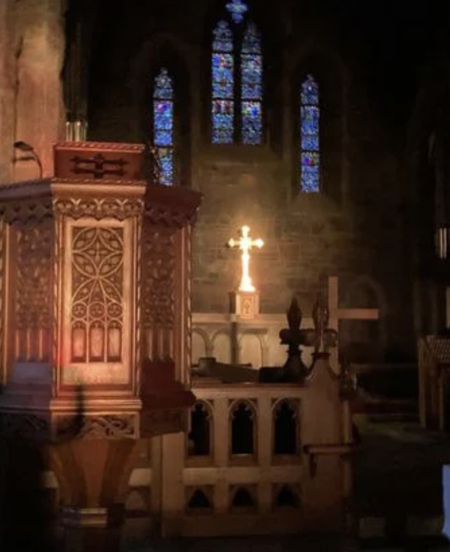
Alleluia, Christ is risen.
The lord is risen indeed, alleluia!
If I could have swapped yesterday morning’s beautiful weather for today’s, I would have, believe me. But we’re grateful for the water, and grateful that this long winter is over. Whenever I’m ambivalent about the rain I remember St. Francis who loved it all, and said “Praised be you, my Lord, for Sister Water, so very useful and humble, precious and chaste”.
[To the kids: Nothing stops Jesus from rising from the dead, and nothing stops an Easter egg hunt. Kids: we’ll be in the Great Hall and you can listen for instructions at the announcements. Have faith!]
So glad you’re all here. Welcome to our visitors, friends, family, neighbors, and kids returning home from college. Good to see you here and a very Happy Easter to all.
I want to share with you something that I came across a few years ago.* It’s someone sharing a story he once heard from the philosopher Peter Rollins. Rollins had given a talk (as you’ll hear in a moment) at a conservative Christian college and later shared an anecdote from that experience. I myself (long time ago) attended a conservative Christian college so maybe that’s one reason it got my attention.
But I’m sharing it b/c I found this very meaningful in my personal understanding of the importance of this day and the resurrection.
Here’s what he says. It’s a little long, but worth it:
A number of years ago I attended a conference that included a talk from Peter Rollins, a progressive philosopher and theologian who grew up in Northern Ireland during the Troubles.
He recounted a time when he was invited to a conservative Christian college to be a part of a panel discussion. Near the end of that conversation a student came up to the microphone and said to him, “Pete, just admit it. You deny the resurrection of Jesus Christ.”
He described how he could feel every eye in that gathering focused squarely on him, including from the other panelists. He responded, “You got me. I fully and completely admit that I deny the resurrection of Christ.” He said you could hear a pin drop in that room. Then he continued, “I deny the resurrection of Christ every time I do not serve at the feet of the oppressed, each day that I turn my back on the poor; I deny the resurrection when I close my ears to the cries of the downtrodden and lend my support to an unjust and corrupt system.”
But [as the writer goes on to say] Pete wasn’t finished yet. “However,” he said, “there are moments when I affirm that resurrection, few and far between as they are. I affirm it when I stand up for those who are forced to live on their knees, when I speak for those who have had their tongues torn out, when I cry for those who have no more tears left to shed.”
I know we come to Easter day with a lot of noise in our heads. We push it back but it’s there:
What is this story?
Did it really happen?
Does the person next to me think this happened?
If I don’t know if this happened, should I be sitting here?
Do I belong?
In my memory as a kid, the Easter Day sermon was the pastor’s one shot to make the case for resurrection. To send us away convinced of the science, the logic, the veracity (whatever) of this event. I remember once thinking, wow, I would never want to do that for a living!
And so I don’t.
I stand in a long line of Episcopalians--Anglicans--whose concern for Easter Day is not to convince you of some scientific truth about resurrection 2000 years ago or resurrection after we die. And this is not to be dismissive of either of these things, at all. These assertions lie at the core of our Christian faith. It’s simply to admit my, or anyone’s, lack of access to this knowledge. So instead, I count myself among those whose primary concern on Easter Day is that we affirm the resurrection in our lives and our actions--not on Easter Sunday or Sundays alone, but every chance we get.
Actions can be much more demanding than assertions of faith we may say out loud. To frame our actions--what we choose to do and what we neglect--in terms of either affirming or denying Christ’s resurrection, is powerful.
We begin by serving the people Jesus served: the overlooked, the abandoned, the fragile and in need of care, in Biblical shorthand, the widow, the orphan, and the stranger. Those without homes to live in, countries to call home, food to put into their children’s mouths, those without the bare essentials needed to live a dignified life. If we’re not doing something for those in greatest need, we aren’t affirming the resurrection. We’re denying it.
Our care extends also to those around us: our neighbors, our children, our parents, our partners. Also the people we pass by in the street, stand next to in line, sit next to in the pew, ride alongside in the train, or drive with in traffic.
And finally, our care extends to ourselves. We affirm the resurrection of Christ when we know that, individually, we ourselves are children of God--good, and loved, and absolutely needing nothing to prove but just with an obligation to spread the love we know is ours to as many people as we can.
Today we will affirm the resurrection with our voices and hymns, our Easter acclamations. Let’s do it loudly and with a purpose as those who also affirm it day in and day out in the world. When the acclamations come, let’s be loud in here. And let our volume be reflected, in our actions Out there.
So now once again, like we mean it!
Alleluia, Christ is risen.
The Lord is risen indeed, alleluia!
Amen.
*with thanks to the source for this, Peter Enns, Biblical scholar and theologian. I wrote this down some time ago in my vast trove of quotes, so if anyone knows the exact source from Enns himself, please let me know!!